Nonfiction
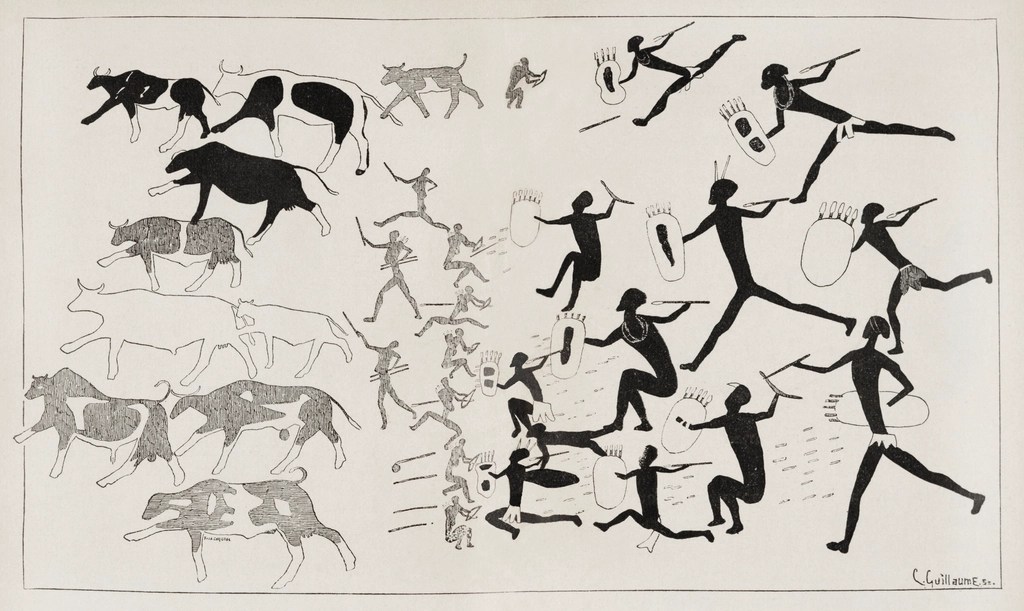
About 100,000 years ago humans found a place to set up a shop and create pigments in a little cave overlooking the ocean on the horn of Africa. They experimented with different colorants and what we would today call “binders” to create paint. After a time, the cave was abandoned, and the humans moved on. Then in 1991 the shop was rediscovered. What they found there is astonishing. Investigators found “toolkits,” consisting of ochre pigments and rocks, evidence of bone marrow as binder to mix the powder and various tools required in the processing and application of the paint. The complexity of the find indicates that the knowledge of how to process these pigments was already well established and perhaps the workshop served as a kind of laboratory to experiment with variations of the process. In addition to the toolkits, evidence suggests that the cave was also used to process “Still Bay Points” a kind of arrowhead and knifes made from quartz. Part of this processing would have included heat treating to make flaking easier.
Our early ancestors had a limited set of materials to work with, wood, bone, dirt, shells, and stone. But they figured out that by heat treating and/or combining materials they could create new materials that improved their lives. Not only in terms of food, shelter, and safety but also to satisfy a creative need. They were the first materials engineers.
There are several definitions of Materials Science and Engineering (MSE). William Callister defines it as:
“…’materials science’ involves investigating the relationships that exist between the structures and properties of materials. In contrast, ‘materials engineering’ is on the basis of these structure-property correlations, designing or engineer the structure of a material to produce a predetermined set of properties.”
The formal discipline of MSE that is taught at university’s all over the world has only been defined since the 1950’s. Before that the scientific and engineering disciplines were divided into physics, chemistry, metallurgy, ceramics, electronics, etc. The relationship between elemental structure, properties and ways to manipulate them wasn’t a formal field of study until 1955 after the government recognized the need for integrated engineering studies. Today, metallurgy and ceramics engineering are subfields of MSE along with polymers, biomimicry and electronics.
We modern humans tend to associate our technology with increased intelligence, but I argue that we are only as technologically advanced as we are because we build our knowledge on the foundation of our ancient ancestors. They were just as smart, just as clever, just as innovative as we are. They were just as violent as we are too. Many materials science advances made in ancient times were in response to war.
My book will aim to show that the story of humans and the story of materials science cannot be told without each other. There are many good books published on this subject, but each has a different approach. My desire is to take you, the reader, back to the place and time of those stories and to show how this knowledge evolved and, I hope, to share my love and enthusiasm for the subject. I will avoid deep scientific explanations of material properties and why the work they way they do – that’s been done really well repeatedly and in the bibliography I will provide a list for further reading. My approach will use the tools of the novelist to weave stories that are purely from my imagination about what I imagine life might have been like (I’m not an anthropologist) but informed by my experience as a materials scientist. Whenever possible I will include a “Try This At Home” section that will describe the materials and processes necessary to replicate the topic in a lab experiment setting. Many materials processes involve high temperatures, and I will include safety information for those experiments.
I’m excited to be able to combine my love of materials science with my second favorite subject, history. And I hope you will come away with a deeper understanding of the materials you use every day. I also hope you will see how despite the wide divide of years and technology, the people who lived in caves and hunted and gathered the resources around them to survive are still very close to us – that we are all formed from the same clay.
 Tuesday Kuykendall
You must be logged in to post a comment.